Japanese Joker
0 onlineENG
Japanese Joker
Japanese Joker for two players — three cards, trumps, and five columns on the table with a face-up card on top of a face-down one.
Open tables
…liveJapanese Joker Online — for Two Players
Japanese Joker for two players — eight cards in hand, trumps or bezi, and five columns on the table with a face-up card on top of a face-down one.
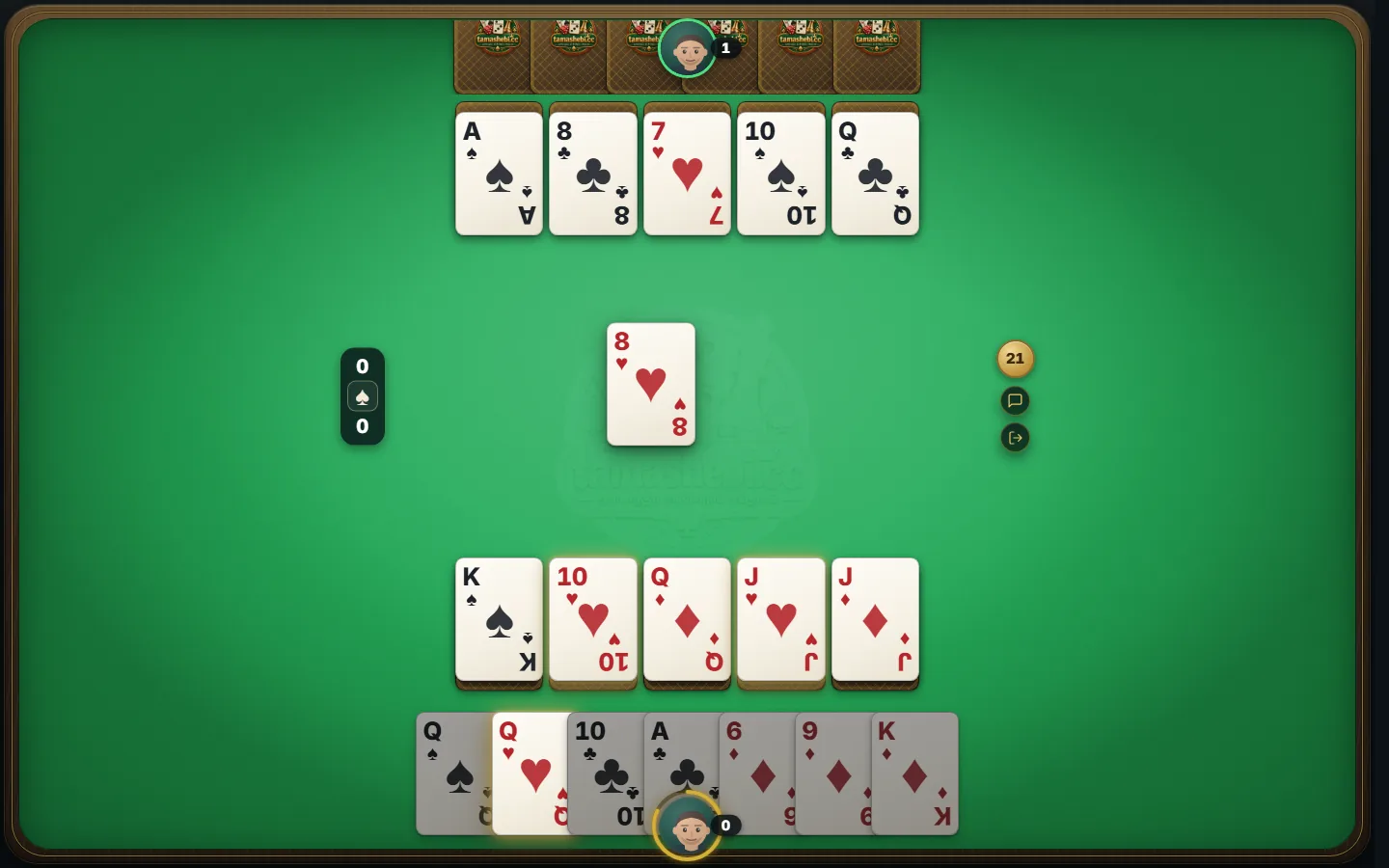
Japanese Joker is played by two players with the same 36-card deck as the classic game — thirty-four ordinary cards and two jokers. There is no bidding here: all the cards are dealt, every hand has 18 tricks, and whoever takes more wins.
How a hand goes
- Both players get three cards each. The declarer — this alternates from hand to hand — chooses trumps based on those three cards: spades, hearts, diamonds, clubs or bezi (no trumps).
- Then each player is dealt 15 more cards: five to the hand and ten to the table — in five columns, a face-up card on a face-down one.
- The declarer leads to the first trick. The first card must be played from the hand; from the second move on, the face-up cards on the table can be played too.
- When you play a column’s face-up card, the face-down card under it goes into your hand — you will play it later, from the hand.
- And so on for 18 tricks, until both players have run out of cards.
The table columns
A column is one play, not two. When you play a column’s top, face-up card, the column empties completely, and the card underneath is not turned over where it lay — it goes straight into your hand. So your hand actually grows during a hand: you start with eight cards, and every column you open adds one more. Until then nobody sees the face-down card — not your opponent and not you. Once it reaches your hand, only you can see it, like the rest of your hand.
One detail often surprises people the first time: the last two columns go together. When you have only two columns left — two face-up and two face-down cards — and you play one of the face-up ones, the table clears completely: the card underneath it and both cards of the other column all come into your hand. A single column is never left standing on its own, and the end of the hand is played from the hand only.
Suit, trumps and the joker
You must follow suit if you can; if not, play a trump; if not that either, any card. Under bezi there are no trumps, so when you cannot follow suit you play any card. The joker is always legal, and here it is always played to take the trick — playing a joker low, “let it take”, does not exist in this game. A joker played on someone else’s card beats any card, trumps included. If both jokers fall in the same trick, the second one takes it.
When you lead a joker, you name a suit. If your opponent has that suit, they must play their highest card of it. If they do not, they must trump if they can. This is the main way Japanese Joker differs from the classic game: if your joker called for a non-trump suit and your opponent, having none of it, played a trump, the trump takes the trick. If your joker called for the trump suit itself, or the hand is played in bezi, it cannot be cut this way — only the other joker can take it.
Scoring
At the end of the 18 tricks the counts are compared and the hand is scored as the difference to whoever took more: 11 and 7 — the winner gets +4, the loser 0. Nine-nine is a draw and nobody scores. The match is won by whoever reaches 21 points — a single hand can be worth up to 18, so going past 21 is normal.
For example, a match to 21 might go like this. In the first hand one player takes 11 tricks and the other 7: the score is 4–0. The second hand ends 9–9 and the score does not change. In the third, the second player takes 13 and the first 5: the second player adds 8, and it is 4–8. One strong hand, say 16–2, is worth 14 points at once, so falling behind is never final until somebody reaches 21.
Creating a table
When you create a Japanese Joker table you choose only what really changes this game. Khishti, premia, moshla and pulkas belong to classic Joker and are not offered here — a setting that changes nothing would only confuse.
- Points to play to: 11, 15, 21 or 31. 21 is selected by default.
- The table is free, or on Domino Coin — 25, 50, 100 or 250 coins. Domino Coin is the game’s internal virtual coin and has nothing to do with money.
- Visibility: “Public”, “Friends” or “Password”. A password table needs a password of at least 4 characters — share it only with the person you are playing.
- An account is not required: you can sit down at a table as a guest too.
Classic or Japanese
- Players: four in the classic game, two in Japanese.
- Bidding: in the classic game, every hand; in Japanese there is none — whoever takes more wins.
- Table: in Japanese, ten cards lie in five columns, a face-up card on a face-down one — the information is part of the game.
- Joker: in the classic game a high joker beats trumps too, and a joker can also be played low; in Japanese the joker always takes, but a trump cuts it when it called for a non-trump suit.
- Scoring: in the classic game, points per hand, with khishti, premia and moshla; in Japanese — the difference in tricks, up to 21.
Tips for beginners
- You choose trumps after seeing only three cards, so do not wait for the full picture: two cards in one suit, especially high ones, are already a good reason to pick that suit. If all three are different suits and low, bezi is often the calmer choice.
- Your opponent’s face-up cards are always visible. Before you lead, look at which suits they have on the table and where they can cut.
- Your opponent knows everything about your face-up table cards and nothing about the cards in your hand. It is often better to use the face-up cards first and keep your hand cards for the end.
- Leading a joker is safest when you call for trumps or play in bezi. When you call a non-trump suit, call one your opponent clearly holds — that way you draw out their highest card.
- The hand is scored by the difference, so every trick matters, even when you are already winning the hand: 10–8 is worth two points, 12–6 is worth six.
Frequently asked questions
- Why is it called Japanese?
- That is what people call the two-player variant of Joker in which some of the cards lie on the table in columns. The name has nothing to do with where it comes from — the game is Georgian.
- Can I see my opponent’s face-down cards?
- No, and your opponent cannot see yours — not even its owner sees a face-down card until it goes into their hand. The face-up cards are public to both players.
- What happens if my connection drops or I leave the match?
- If your connection drops, you have time to come back, and when you return you carry on with the same hand. If you do not come back in time, or you leave the match yourself, the match counts as lost — in a two-player game there is nobody else to play your seat.
- Can I play with a friend?
- Yes. Create a table with “Password” or “Friends” visibility, and share the password only with the person you are playing.
- Is it free?
- Yes. There are free tables and Domino Coin tables.