Bura
0 onlineENG
Open tables
…liveBura Online — the Georgian Card Game
Georgian bura online: three-card and five-card for two players, five-card in pairs for four. Trumps, davi raises, bura, maliutka and the “var” claim — free.
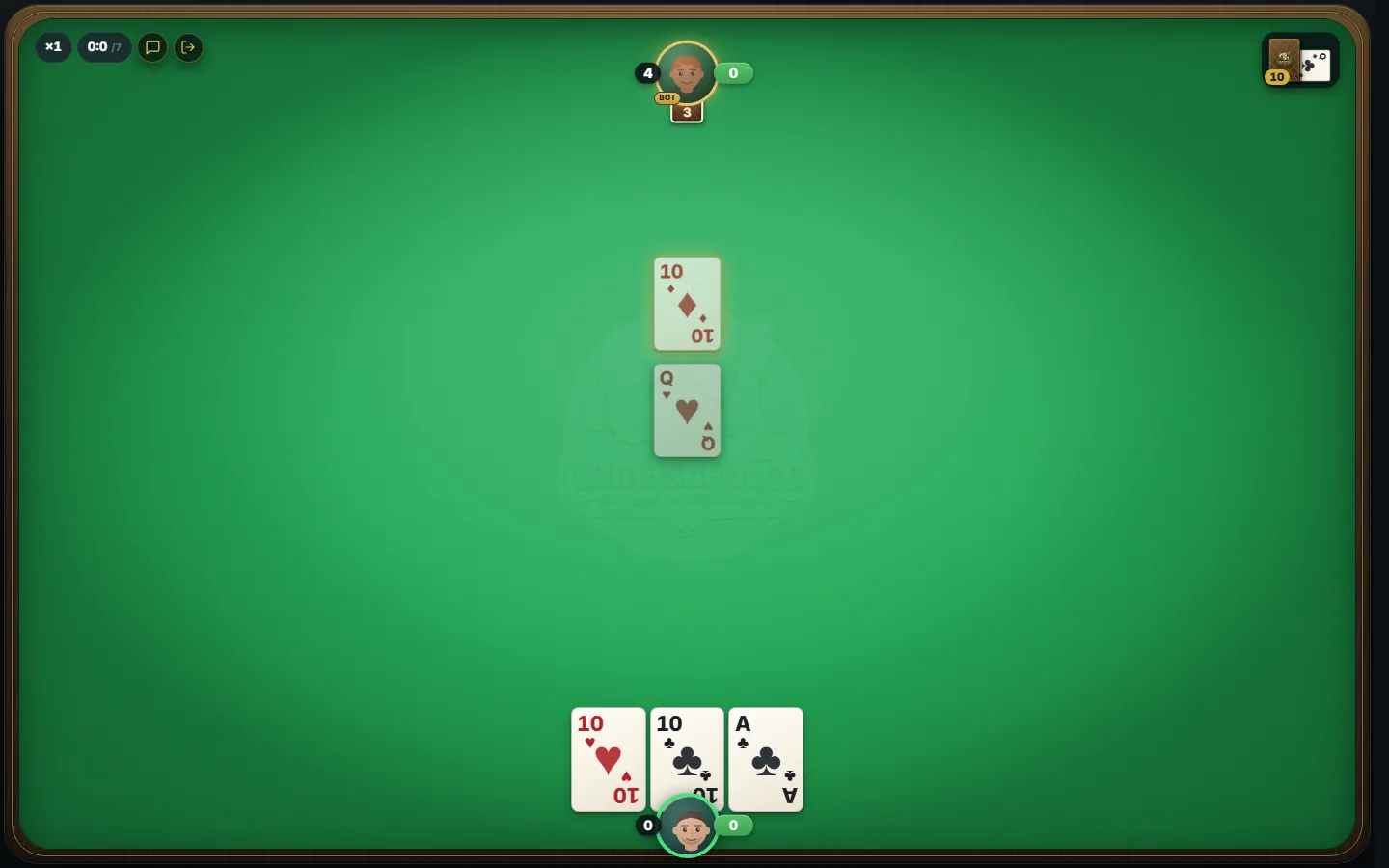
Bura is one of the best-loved card games in Georgia: fast, loud and built entirely on counting. Whoever keeps track of the points they have taken and says “var” at the right moment wins. Here bura is played by the rules of the Georgian table — trumps, davi, bura and maliutka — and you choose from three modes.
How to start
- Choose a mode: three-card, five-card or five-card in pairs.
- Choose the match length — 1, 3, 7 or 11 points — and press “Play”: you join an open table, or a new one opens and waits for an opponent. To practise, you can fill the empty seats with bots.
- Or create a table and send the link to a friend; in pairs you can fill all four seats with friends.
- To practise, choose a bot — it plays by the same rules, so you can learn to count and to call davi with no pressure.
Three modes
- Three-card bura — two players, a 20-card pack (ace, ten, king, queen and jack in all four suits), three cards in hand. The hand goes to whoever takes 31 points.
- Five-card bura — two players, a 36-card pack (six to ace), five cards in hand. You need 61 points to win; 60:60 is a draw.
- Five-card in pairs — four players in two teams; partners sit opposite each other. Five cards in hand, and a team needs 61 points — both partners’ tricks count together.
Cards and points
- Ace — 11 points
- Ten — 10 points
- King — 4 points
- Queen — 3 points
- Jack — 2 points
- Nine, eight, seven, six — 0 points
By strength the cards rank ace, ten, king, queen, jack, nine, eight, seven, six — so the ten beats the king. Both packs hold 120 points in all: the 20-card pack simply has no zero-point cards. That is why 31 in three-card bura is just over a quarter, and 61 in five-card bura is one more than half.
Trumps and play
- After the deal, one card is turned face up under the stock — its suit is trumps. That card is the last one drawn from the stock.
- The leader plays one card or several, but they must all be of one suit.
- The responder answers with exactly as many cards: either beats every one of them — each by a higher card of the same suit or by a trump — or gives the same number of cards. There is no partial beating: all or nothing.
- In three-card bura, given cards go face down — your opponent cannot see what you gave.
- The best play takes the trick, and whoever took it leads next.
- After each trick the hands are filled from the stock — the trick winner first — until they are full or the stock runs out.
In pairs, beating always concerns the best play standing on the table. If your partner has already beaten the lead, you can give a card — the trick still goes to your team.
Bura and maliutka
A bura is a hand of nothing but trumps: three in three-card bura, five in five-card. Play them all at once and the hand is yours on the spot, without counting a single point. A maliutka is a full hand of one non-trump suit: leading it all at once is a strong play, and a table option can allow a maliutka to be led out of turn.
“Var” — winning the hand
Nobody sees the points taken — not even you, unless the table turns that on. Counting in your head is part of the game. When you take a trick and believe you already have 31 (61 in five-card bura), say “var” before your next lead. The points are counted: if you really have enough, the hand is yours; if not, you lose it. If nobody says “var” before the cards run out, the hand goes to whoever has more points.
Davi — raising the hand’s value
A hand is normally worth one point, but before leading, the leader may raise its value. The ladder goes:
- Davi — 2 points
- Se — 3 points
- Chari — 4 points
- Panji — 5 points
- Shashi — 6 points
The opponent accepts, declines — and then loses the hand at its value before the raise — or raises again to the next step. Raises alternate between the sides: one side cannot raise twice in a row. Under the Crawford rule, the first hand in which either side is one point from the match is played without raises. Davi changes match points and nothing else.
The match
When you create a table you choose how many points to play to: 1, 3, 7 or 11. A won hand adds as many match points as it was worth — usually one, up to six with davi. A draw scores for nobody. The winner of the last hand leads the next one.
Terms
- Kozir (trumps) — the suit of the card turned up under the stock; it beats any other suit.
- Beating — covering the led cards with higher cards of the same suit or with trumps.
- Giving — playing the same number of cards without beating; the cards go to the trick winner.
- Bura — a hand of nothing but trumps; played at once, it wins the hand outright.
- Maliutka — a full hand of one non-trump suit.
- “Var” (“I have it”) — the claim that you have already taken enough points.
- Davi, se, chari, panji, shashi — the steps of the hand’s value, from 2 to 6.
- Hand — one deal played out; a match is several hands.
Frequently asked questions
- Is bura free?
- Yes. The game is free and real money plays no part anywhere on the site. Domino Coin is virtual and cannot be exchanged for money.
- Which mode should I start with?
- Three-card: a hand takes a few minutes and you learn the rules quickly. Five-card is longer and asks for more counting, and in pairs you play together with a partner.
- Why can’t I see the points I have taken?
- Because it is the same at the table: counting is part of bura, and the game turns on saying “var” at the right time. Showing your own points can be switched on when you create a table.
- Can I play against a bot?
- Yes. The bot plays by the same rules and is good for practice — whenever you like.
- What happens if I say “var” too early?
- You lose the hand at the value it was being played for. So say it when you have really counted.